Thursday, July 18, 2013

Sylo, by DJ MacHale

I read several reviews of Sylo, by D.J. MacHale that said the book was terrible, but I disagree! A lot of people complained about the erratic pacing of the novel, but I felt like it kept the novel fresh and propelled me to keep reading.

Anyway, the novel's main character is a kid named Tucker Pierce. He's just average - he pulls a solid B average in school, sits the bench on the football team, and doesn't really have anything to set him apart from the crowd. However, that all changes the night a member of his football team dies. Suddenly, Tucker is shot into the spotlight as he takes over the kid's position. He learns more and more about his teammate's untimely death, specifically the part that a mysterious crystalline drug called "The Ruby" played in it; what he learns could be the downfall of his quaint hometown, Pemberwick Island, Maine. Before long, Pemberwick is under government-enforced quarantine, and no one can figure out why. Except, that is, for Tucker and an odd crew of his peers. They're not sure if they'll be able to save their island, but they sure will try!

This novel was a bit violent, and there was some bad language, but I wouldn't let that keep me from recommending it to my students next year, especially boys. I saw some big parallels between this novel and The 5th Wave, by Rick Yancey. For instance, the way main character Tucker describes the deaths on his island is very similar to the way the protagonist describes the "waves" of death in 5th Wave.

I know Sylo is the first in a series, but I can't find anything about the second book...anywhere!

Also Try: The 5th Wave, by Rick Yancey; Hero, by Mike Lupica

Monday, July 15, 2013

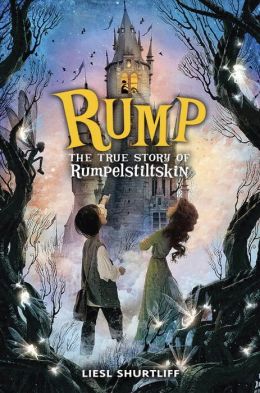
Rump: The True Story of Rumpelstiltskin, by Liesl Shurtliff

Rump: The True Story of RumpelstiltskinRump is the "true" story of Rumpelstiltskin. Rump is a small boy - literally, he's 12 years old and has not grown in a few years - who lives with his grandmother. He knows that "Rump" is only part of his name, but his mother died in childbirth before she could get out the rest of his name. So, aside from being made fun of for his size, he's gone through life being picked on for his name, which means butt.

The people of Rump's town, The Mountain, put a lot of stock in names and spend lots of time dreaming up children's names. In fact, they spend so much time on baby names that they don't name anything else - not animals, locations, nothing. So you can see how this presents a huge problem for Rump.

Life in The Mountain is largely based on gold mining, and the harvest has been minimal, so families are left hungry. Rump finds an interesting way to combat this hunger when he learns that he can spin straw into gold. Of course, though, this revelation makes more trouble than it appears to be worth. Will Rump be able to sort out his new-found talent and better his life and the lives of the people around him?

I liked Rump, and felt drawn in from the beginning, but I didn't love it. I did like the opening pages in which Rump describes his unfortunate name. He says:

"Your name is full of meaning and power. Your name is your destiny." (2).

I just loved this idea, and found myself thinking a lot about the importance of names: how sometimes a person's name doesn't fit their personality, or their appearance, and about the amount of time that people even in this country, spend poring over baby name books. It's an interesting topic to ponder.

Also Try: The Grimm Legacy, by Polly Shulman; A Tale Dark and Grimm by Adam Gidwitz

Sunday, July 14, 2013

Ripper, by Amy Carol Reeves

Ripper was recommended to me by a librarian friend, but I didn't realize that the author was from Columbia, SC, where I used to live! I wish I had read it before I moved away!

Ripper is, obviously, about London's infamous Jack the Ripper murders. The novel's protagonist, Abbie (short for Arabella) has recently relocated to London to live with her grandmother after her mother's death, and finds herself volunteering in Whitechapel Hospital, whose recently discharged patients are the target of the Ripper's violence. Abbie knows from the start that she's all too close to the murders - in fact, she has visions which predict their occurrence - but things take a unique turn, and she finds herself much more involved in the strange plot than she would have imagined. Along the way, she gains new insight into her mother's life and the lives of the doctors around her.

This book was the first in a series, and the ending was a perfect cliffhanger - I just have to know what's going to happen next in the series. I also loved the main character's medical aspirations, which were uncommon of a woman in that time period. Some parts of the novel, unfortunately, were pretty predictable, though. For instance, there's a significant part of the story surrounding Abbie's acquaintance Mariah. I predicted how this part of the plot would turn out from the beginning. Also, parts of the novel got a little dull; however, if you don't mind skimming through some parts, it worked out fine!

I am wondering though, what is up with the insurgence of Jack the Ripper novels?! I recently started the "Shades of London" series, which center around the Ripper, and there were a few students in my class last year who read a different Ripper, by Stefan Petrucha.

Also Try: The Name of the Star, by Maureen Johnson; Deadly, by Julie Chibbaro; Wrapped, by Jennifer Bradbury

Saturday, July 13, 2013

The Wrap Up List, by Steven Arntson

I was really intrigued by the premise of this book. In the novel, about 1% of all deaths are attributed to what the people call "Departures". What this means is that people "depart" from earth without really dying in the normal sense that we think of the word. "Departures" are summoned by one of several "Deaths" - ghost-like people who summon and accompany people into their departure.

The novel is set at a time when the world is on the brink of war, so the number of "Departures" has risen globally. Main character Gabriela is, unfortunately, selected for departure at just 16. Gabriela goes through the normal motions of a departure - submitting a "Wrap Up List" almost like a bucket list - to her Death, who happens to be Hercule, waiting for a reply from him with hints about his "Noble Weakness". The "Noble Weakness" is almost like a character flaw that is unique to every Death. If you can figure it out, you are granted a "Pardon" and do not have to Depart. Obviously, Gabriela is determined to, with the help of her friends, figure out what Hercule's Noble Weakness is so that she can avoid an untimely departure.

The details surrounding Gabriela's departure become increasingly perplexing - another boy at her school is scheduled to depart with the same Death, which is highly unusual. Then there's the fact that, after doing some research, Gabriela realizes that her Death, Hercule, granted a Pardon to her grandfather years and years ago, during a war in Tunisia. Are all of these things clues into Hercule's Noble Weakness, or will Gabriela wind up departing on schedule?

I absolutely loved the writer's style and lots of particular aspects of the book. For instance, Gabriela's family pretty much centers their lives around their Catholic church and their priest. I loved this aspect about the book, and loved Gabriela's conversations with their priest, Father Ernesto, as she questions some of the big dilemmas in life. I also loved how the author kind of examined rituals and milestones that we all have in common. One of my favorite was the ritual of high school football games. I loved this passage, beginning at the playing of the National Anthem at a Sunday evening football game:

"Everyone, on both sides of the field, rises. I've been through this many times, and it has never occurred to me to wonder about it, but looking down on the field now...as we all ritualistically cover our hearts - it's just like church. When the first notes are played, everyone, and everything comes to a halt...The players, the cheerleaders, the band, even the crowd - this entire stadium and everything that takes place in it is a uniform we have all decided to put on together. To forget ourselves. 
As the ritual of Mass prepares the congregation to receive the Body of Christ, so the cheer squad prepares the fans to receive the varsity team." (116).

This really was one of those novels that made you think, and I will recommend it heavily next year. There is some mild language and a very brief exploration of sexuality. 

Friday, July 12, 2013

Twerp, by Mark Goldblatt

The back cover of Twerp simply says, "a good book about a bad deed," and that couldn't be more true.

Julian Twerski, Twerp's main character, is a sixth grader at PS 23 in Queens, NY in the late 1960s. Julian, or "Twerp", as some of his friends call him, finds himself in trouble during the school year, ultimately landing himself suspended. Upon his return to school, his English teacher, Mr. Selkirk, gives him a writing assignment: he must write about the "bad deed" that got him suspended in order to make up for the assignments missed during his time out. The result of Julian's writing assignment is this book - it chronicles his adventures (or mis-adventures) with his crew of friends, mainly in their hangout of choice, a field they have nicknamed "Ponzini".

I loved this novel for several reasons. First, it explored things that real-life boys STILL do. For example, Julian and his friend Lonnie mess throw rocks at pigeons for fun, not really expecting to hurt one. But, inevitably, they do, and have to figure out how they're going to deal with it. Also, Julian's writing assignment was to write about the act that got him suspended, but he avoids this for a really long time. This hooked me in and made me want to keep reading. He didn't actually address the cause of his suspension until the very end of the book. I loved this not only because it propelled me to keep reading, but also because I think it's a really great lesson for kids about how we make sense of things through our writing.

I can't wait to recommend Twerp to my students in the fall. I think it's the kind of realistic fiction that kids really connect with.

Thursday, July 11, 2013

Zebra Forest, by Adina Rishe Gewirtz

I was expecting a lot out of this book. I loved the cover (I know, I know...) and was super intrigued by the title. It's also the author's debut novel, which always piques my attention.

Zebra Forest is about two children, Annie and Rew - short for Andrew - who live with their mildly eccentric grandmother. They receive frequent visits from a social worker, and don't get to much pleasure out of going to school. They do love reading their grandmother's tattered copy of Treasure Island and playing in the "zebra forest" that's near their house. They don't really know what happened to either of their parents; all they know is that their mom left them and that their father is apparently dead. However, after a jailbreak at the local prison, an escaped convict takes shelter in their house and holds the family of three hostage. They learn new things about their past, and question what they've always thought to be true of their parents.

During the whole novel, I felt like I was waiting for something to happen. There were some big events - such as the convict entering the house - but none of it felt very climactic. I did like the idea of rethinking our views about family and lying, but I just don't see this as a book that would really grab my students. I'll have to see what they think come August!