Showing posts with label middle school. Show all posts

Friday, May 8, 2015

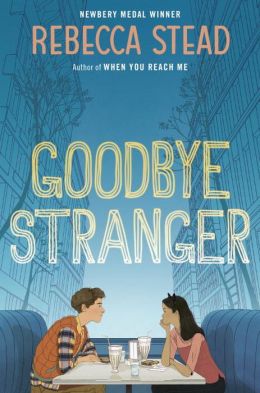
Goodbye Stranger, by Rebecca Stead

Goodbye Stranger is the third Rebecca Stead novel I've read. I had to read one of her earlier novels, When You Reach Me, during an undergraduate course. I read Liar and Spy a while ago, and loved it, as did several of my students.

Goodbye StrangerGoodbye Stranger is about several different characters and how their stories intertwine, but at the heart of the novel is Bridge Barsamian. Bridge survived a terrible accident in elementary school and was told by her nurse in the hospital that she must have survived for a reason. So, she's hard at work trying to figure out what that reason is. Bridge has two best friends, Emily and Tab, who have been by her side through it all. However, the novel starts when they're in 7th grade and things are changing. Emily has newfound popularity and curves, and is beginning to experiment with more mature things - sending nude pictures, boys, etc. Bridge and Tab aren't quite ready for that yet, and seem a little less "advanced" than their good friend Emily. But, the three of them navigate this uncharted territory together and come out still friends in the end. This was the only mildly unrealistic part of the novel - I don't think most pre-teen friendships would survive under these circumstances. But maybe it will give readers some hope and a model of how things could work out.

I really loved all the different themes, conflicts, motifs, and stories that blended together during the novel. It keeps things interesting and propelled me to keep on reading. I think my students, specifically female students, will enjoy reading this novel.

Also Try: Liar and Spy, by Rebecca Stead; Drums, Girls, and Dangerous Pie, by Jordan Sonnenblick

Monday, February 9, 2015

Zane and the Hurricane: A Story of Katrina, by Rodman Philbrick

As I've mentioned before, I love a good story about Hurricane Katrina. I love a story about Hurricane Katrina EVEN MORE when I see that it's written by Rodman Philbrick. I've been able to get even the most reluctant of readers hooked into Philbrick's characters and novels, so I knew this one would be good.

Zane and the HurricaneZane and the Hurricane has an interesting twist in that Zane is accidentally in New Orleans when Katrina hits. He's visiting a relative he barely knows and has never been to the city before. When the mandatory evacuation notice is announced, he and his great-grandmother attempt to leave the city, but he's left behind when he chooses to follow his canine companion. Zane weathers the storm in his great-grandmother's house, alone except for his dog. Shortly after, he's picked up by some passers-by in a canoe. These aren't Red Cross workers or anything, they're just a man and a girl who were left behind as well. Zane comes to learn that they are acquainted with some unsavory characters, and he's put into some extremely dangerous situations. However, it all works out in the end.

What I love the most about the story is the way the "ugly" parts of Katrina's aftermath are captured, but not dwelled upon. For instance, the trio find themselves near a wealthy section of town. They're hoping to use a phone or bathroom, but instead are accosted by a group of helicopter-borne vigilantes, who are paid to protect the prestigious homes from looters. Zane and his friends are far from looters, but the whole city is suspicious, especially of African Americans.

That's another part of the story that's so interesting - Zane is half white and half black, at a time when racial tensions in the city were heightened. This is constantly brought to light as he struggles to survive in the wake of the hurricane. Additionally, during his time in New Orleans, Zane learns things about his family and his family's past (his father is dead) that he never knew and that help him understand where he's from.

Also Try: Ninth Ward, by Jewell Parker Rhodes; St. Louis Armstrong Beach, by Brenda Woods; Freak the Mighty, by Rodman Philbrick

Sunday, February 2, 2014

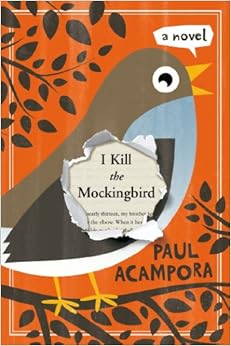
I Kill the Mockingbird, by Paul Acampora

I loved I Kill the Mockingbird, by Paul Acampora, but unfortunately I don't think it's the type of book that would appeal to most of my students. They seem to hunger for books with adventure, big plots, mystery - this book doesn't really have any of those.

I Kill the Mockingbird is about three 8th graders: Lucy, Elena, and Michael. They're best friends and all attend the same school, at which Lucy's dad is the principal. Lucy's mom has recently returned home after a long hospitalization with cancer, and Elena lives with her uncle above the bookstore that he owns. During their eighth grade year, one of their favorite teachers, Mr. Nowak, dies of a heart attack. Their replacement teacher, Miss Caridas, assigns a list of options for summer reading, one of which is To Kill A Mockingbird.

In an effort to pay homage to Mr. Novak and force kids to read the book, they hatch a social media campaign to spark interest in the novel. They call their campaign "I Kill the Mockingbird", and begin to hide TKAM books at local bookstores and libraries to garner even more intrigue. Soon, people around the country are involved in the campaign, and it seems to be getting out of control.

My favorite quote from the book:

"You might be thinking that you're already a good reader...It's not enough to know what all the words mean. A good reader starts to see what an entire book is trying to say. And then a good reader will have something to say in return. If you're reading well, you're having a conversation."

I Kill the Mockingbird was smart and well-executed, but like I said, I don't think it will appeal to many of my students - it just doesn't seem to be the type of book they go for. I'll definitely recommend it, though, and hope one of them will fall in love with it and prove me wrong!

Publication Date: May 20, 2014


Wednesday, December 11, 2013

The Heartbreak Messenger, by Alexander Vance

The Heartbreak Messenger is about an average, run-of-the-mill kid named Quentin. Quentin's dad left when he was six years old, and he and his mom have been just barely seeking by ever since.

 Quentin's best friend Rob's older brother one day approaches Quentin with a proposition: he wants to break up with his girlfriend but doesn't want to go through the trouble of having to do it himself.  So, he offers to pay Quentin to make the break for him. Quentin sees this as a lucrative opportunity, and before he knows it, he's running a full-fledged business.

Word spreads about his services, and high schoolers are approaching him constantly. Some of his 'clients' are less than desirable, and Quentin even winds up with a black eye. Before long, much discussion surrounds this mysterious, elusive, "Heartbreak Messenger", and Quentin struggles to keep his identity a secret.

Before long, his other best friend, Abby, has figured out what Quentin's up to, and is none too satisfied with his actions. Will Quentin stop, or is the money too good?

I LOVED this book - it was fast-paced, the characters were lovable, and the premise was so funny. It does have a romantic ending, but I'd recommend it to both boys and girls. It would really appeal to both.

Here's a book trailer from youtube:


Sunday, August 4, 2013

Counting by 7s, by Holly Goldberg Sloan

I read I'll Be There, by Sloan, last year and enjoyed it, so I was really looking forward to Counting by 7s to come out. I also really enjoyed it, but think I liked IBT just a little bit better.

Counting by 7s is about a girl named Willow Chance who's a little different. First there's the fact that she's adopted, and then there's the fact that she's somewhat of a genius - her mind works differently than others and she excels at nearly everything she tries. She's particularly obsessed with science, especially diseases and medical disorders. Her favorite number (as you might discern from the title) is 7. Despite her oddities, Willow feels perfectly blessed for her adopted parents, and they let her pursue all of her various interests. All that changes, though, when her parents are killed in a tragic car accident. Since her parents had no other family and didn't have any close friends, Willow's future suddenly becomes incredibly uncertain. However, she's able to buy some time by living with her new friend Mai's family. Through living with Mai's family, she learns to rediscover and accept herself after her parents' death, although the fear of permanent foster placement is always threatening. Willow does have a happy ending, but I'll let you find out how!

I truly loved Willow's voice and the deep reflection with which she viewed the world. After reading this and Sloan's other book, I would definitely say that her most noticeable gift in writing is character development. Both novels had characters with lifestyles/experiences completely different from my own, but by the end of the novel, I found myself able to predict how they would think and act. I also loved how the novel wound so many different characters' lives - Dell Duke, the school counselor; the Nguyens, the only Vietnamese family in town; Jairo, the taxi driver; and of course Willow - together seamlessly and through alternating viewpoints. It really kept things moving and propelled me to read more.

I love Sloan's writing, and there were lots of quotes that I truly loved - here are a few:

"It said I was 'highly gifted'. Are people 'lowly gifted'? Or 'medium gifted'? Or just 'gifted'? It's possible that all labels are curses. Unless they are on cleaning products. Because in my opinion it's not really a great idea to see people as one thing." As a teacher, I just loved this quote. 

"It has been my experience that rewarding and heartbreaking often go hand in hand."

"All reality, I decide, is a blender where hopes and dreams are mixed with fear and despair. Only in cartoons and fairy tales and greeting cards do endings have glitter."

Given this beautiful language and the plot of the story, I think this novel will really appeal to girls in my class who are already strong, self-motivated readers. 

Also Try: Mockingbird, by Kathryn Erskine; Wonder, by RJ Palacio

Tuesday, July 30, 2013

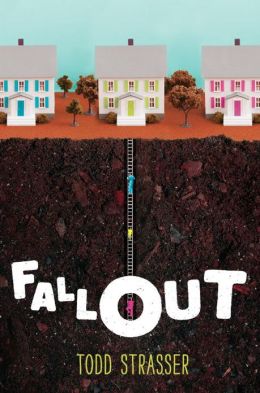
Fallout, by Todd Strasser

FalloutWow! I loved Fallout by Todd Strasser! Judging from the reviews and press I've read about the novel, it seems like most people did as well. I don't know why I didn't make the connection when I started reading, but I realized on his website that Strasser also wrote The Wave, which I had to read in my 8th grade Reading class. I remember hating the teacher, but loving that book and its implications.


Fallout is set during the Cuban missile crisis. Things between the U.S. and Russia are tenser than ever, and all anyone can seem to talk about is whether or not this tension will result in a nuclear war. Main character Scott's father believes that it will result in the war to end all wars, a nuclear war, and is determined to prepare his family for the worst. So, he builds the only nuclear bomb shelter in the neighborhood, right in the family's back yard. This becomes the subject of some ridicule for Scott and his younger brother Sparky, but all of that changes when a bombing actually occurs. Now, all the neighbors who were so critical at the start suddenly want in to the shelter to protect themselves and their children. Some of Scott's neighbors force their way in, and they spend a little over a week together cramped up in the shelter, getting to know each other more intimately than they ever imagined, all the while constantly wondering if they'll get out and what they'll see when they do.

I often find myself falling in love with characters, or caring about them in a way I would care about a real person. But this novel was different - I didn't actually feel a particular liking for any character (although I felt a particular disliking for nasty-neighbor Mr. McGovern), but I experienced something I don't often get to with novels: I felt like I was right there with the characters. The way that Strasser described the tension in the shelter and the anxiety of the neighbors made me really feel like I was living it with them - horrifying and intriguing.

I also loved the way Strasser examined human nature - the way the characters changed from ridiculing Scott's dad's shelter to wanting in on it, and then once they were in, criticizing his hap-hazard gathering of items like food, water, clothing, etc. - the ultimate "looking a gift horse in the mouth," would have to be critiquing the man who saved your life. I really loved watching these changes unfold and seeing how unpredictable people can be when faced with catastrophic events. For instance, one of the characters, Mrs. Shaw, says she would never be able to sacrifice someone else's life to save her own. She's obviously shocked when she learns that her husband did just that: he helped Scott's dad keep too many people from getting into the shelter, essentially killing them.

The only potential problem that I see with this novel, and I think it's one that can be avoided, is that kids might think this actually happened. I feel like most of the historical fiction kids read is based on a main event that actually happened, with other, minor events and characters being fictitious. However, the major event in this novel is fictitious. There was no bombing. I would like to think that my students who read this book would be curious enough to do some of their own research, but I know that's not always the case. I'll be mindful of this when booktalking it and suggesting it to kids.

Also Try: 90 Miles to Havana, by Enrique Flores-Galbis; A Long Walk to Water, by Linda Sue Park; The Wave, by Todd Strasser
Friday, July 12, 2013

Twerp, by Mark Goldblatt

The back cover of Twerp simply says, "a good book about a bad deed," and that couldn't be more true.

Julian Twerski, Twerp's main character, is a sixth grader at PS 23 in Queens, NY in the late 1960s. Julian, or "Twerp", as some of his friends call him, finds himself in trouble during the school year, ultimately landing himself suspended. Upon his return to school, his English teacher, Mr. Selkirk, gives him a writing assignment: he must write about the "bad deed" that got him suspended in order to make up for the assignments missed during his time out. The result of Julian's writing assignment is this book - it chronicles his adventures (or mis-adventures) with his crew of friends, mainly in their hangout of choice, a field they have nicknamed "Ponzini".

I loved this novel for several reasons. First, it explored things that real-life boys STILL do. For example, Julian and his friend Lonnie mess throw rocks at pigeons for fun, not really expecting to hurt one. But, inevitably, they do, and have to figure out how they're going to deal with it. Also, Julian's writing assignment was to write about the act that got him suspended, but he avoids this for a really long time. This hooked me in and made me want to keep reading. He didn't actually address the cause of his suspension until the very end of the book. I loved this not only because it propelled me to keep reading, but also because I think it's a really great lesson for kids about how we make sense of things through our writing.

I can't wait to recommend Twerp to my students in the fall. I think it's the kind of realistic fiction that kids really connect with.