Monday, May 14, 2012

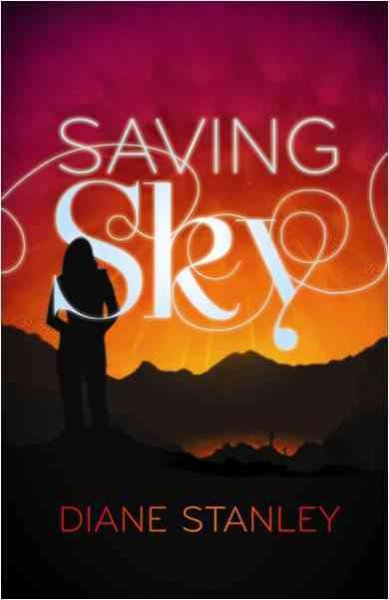
JBA Post #16: Saving Sky, Diane Stanley


I found the idea behind this novel really interesting, but I didn't actually enjoy the book too much. I think that I was expecting it to be more action-packed than it was.

Sky, the main character, lives with her family on a ranch in New Mexico. America is fighting a war against terrorism, and there are constant terrorist attacks. One attack results in the entire power grid for the nation being wiped out. This sparks lots of anti-Muslim sentiments. In fact, the government even opens detention centers just for Muslim citizens and begins to round them up and imprison them there.

A boy at Sky's school comes under question (because his family is Muslim) and she and her family take him in to hide him from being detained. They try as hard as they can to keep him safe - do you think they can succeed?

I did find Sky to be a really likable character, and thought the book had a great message - a few people is all it takes to make a difference - but overall the book did not meet my expectations.

Thursday, May 10, 2012

JBA Post #15: A Long Walk to Water, Linda Sue Park

The stories in A Long Walk to Water, by Linda Sue Park, span two continents and almost three decades, and connect the lives of two very different people.

Nya is a young girl of the Neur tribe, living in Sudan in 2008. She is charged with collecting water for her family - a rough task since there isn't much potable water close to her village. She has to make a long journey to the water source, and even then, the water is unfit for drinking, but it's all they have. Until, that is, foreign men come into her village and begin drilling a well, saying that there is a clean water source right under their feet, deep under the surface of the earth.

Salva is also from Sudan, but from a different tribe - the Dinka - a tribe long at the war with the Neur. Salva's story begins in the 1980s, during the harsh Sudanese civil war. Salva becomes separated from his family and becomes the leader of the 'Lost Boys', a group of boys that traveled 1000s of miles by foot to refugee camps in Ethiopia and Kenya.

Years later, Salva is lucky enough to be adopted into a family in America, but he obviously cannot let go of his African roots, and curiosity about his lost family consumes him. One day, he receives an email saying that his father is alive, hospitalized in Africa. He travels to see his father, and learns that he has a stomach condition that has grown from drinking dirty water. Salva longs to do something to aid his people with this issue of unclean water.

Can you guess how Salva and Nya are related?

This book is based on a true story - Salva is a real person. I really enjoyed it, and liked how it alternated from the past to the present, between Nya's voice and Salva's. There are some upsetting scenes, though, such as when the refugees are kicked out of the camp and have to swim through crocodile-infested waters with soldiers shooting at them.

Wednesday, May 9, 2012

The Lost Songs, Caroline B. Cooney


.

I've never read a novel by Caroline B. Cooney before, because for some reason I always thought she would write things I didn't like. However, I loved this book
The Lost Songs, simply put, is about a girl named Lutie who lives deep in the South and who has a unique possession - she is the only person that knows all the words to a plethora of songs that her great-grandmother, an African American, used to sing during her work-time. A music education professor learns of the songs and becomes interested in them. He wants to publish the songs and bring them to the rest of the world. Lutie doesn't like the plan, though - she feels like the songs are hers alone, and that sharing them would ruin them. She doesn't want them to become commercialized or for people to try to interpret them and alter their original purpose.

The novel is so much more though. The other characters in Lutie's life are so interesting and draw you in - I felt like I had a personal relationship with each character. There's her crazy, drug addict mother whom Lutie has never really known, but contacts her to reveal a secret. Then, there are her aunts, Grace and Tamika, who raise her in her mother's absence. And there's Miss Veola, her dead grandmother's best friend and the pastor of their somewhat eccentric church. Lutie also deals with Doria, a new-to-town girl from up north who is experiencing a deep case of culture schock. Then there are Kelvin and Cliff (a.k.a. "Train"), the boys that Lutie grew up with but has grown apart from. In fact, Cliff lives life on the edge, aspiring to follow in the footsteps of his now-imprisoned older brother, DeRade. It's hard to think about how all these characters and perspectives could come together to create one cohesive story, but they do, and they do so beautifully.

I loved everything about this book - it really has something for everyone. I would recommend it mainly to girls, and anyone interested in music since a lot of the plot is driven by Lutie's knowledge of the Lost Songs and by Doria's link to them since she is an organist. There are parts of the plot that would appeal to boys, too though...some violence and action!

On a side note, this is the first book I've ever read entirely on my iPad, and I must say I did NOT like it. The first page of each chapter had a little snippet of what was to come on it, and I think I would have gone back and re-read those if I'd been reading a print book, but I didn't on the iPad because it was too frustrating to flip back and forth.
Monday, May 7, 2012

JBA Post #14: Woods Runner, Gary Paulsen


I remember reading Hatchet, by Gary Paulsen, when I was in middle school, so it was fun to read another one of his books.

Woods Runner is set during the Revolutionary War and is about a boy named Samuel, who lives out in the forest with his family. One day, he's hunting for bear, and returns to see that his family's cabin has been burned and the entire settlement they live in has been decimated. He finds the bodies of his neighbors everywhere, but notices that his parents' bodies are not among the dead. This leads him to believe that his parents are in fact still alive, and prisoners of war, so he sets out to follow the attackers and find his parents.

Samuel receives help along the way and even picks up a pseudo-sister when her parents are slaughtered in front of her. Ultimately, Samuel's quest is successful and he is reunited with his parents. But after all that he has seen - all the death and destruction - will he ever be the same?

Each chapter began with a sort of historical note about some aspect of war - war orphans, Revolutionary War weapons, treatment of prisoners, etc. - I found those passages really interesting and they were matched quite nicely with what was going on in the plot. This mixture of history and fiction really helped round out the book and made it go by quickly.

I'd recommend this book mainly to boys, especially those interested in war.

Friday, May 4, 2012

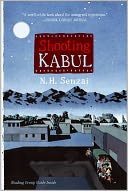
JBA Post #13: Shooting Kabul, N.H.Senzai


Shooting Kabul

Shooting Kabul was an intriguing book. It starts off in Afghanistan. Fadi and his family live there but his parents see that things are getting tenser and tenser as the Taliban takes more control, and they know that they need to leave and get to America.
So, they pay human traffickers to take them over the border and eventually to America. During their middle-of-the-night journey, though, a member of the family - the youngest daughter, Mariam - is lost. The family leaves Afghanistan without her, and each member of the family carries a huge guilt, thinking that he/she is responsible for losing Mariam.

Once in America (California, to be exact), Fadi and his family struggle to fit in while still keeping hope alive to be reunited with Mariam. Fadi learns of a photography contest at school that could earn him a plane ticket to India - right near Afghanistan - and he becomes obsessed with winning the competition, and getting back to Afghanistan to find his baby sister.

That doesn't exactly work out for him, but the book does end on a happy note.

I loved this novel, especially because it's about a topic that really interests me. I love to read about the Middle East, the fighting there, etc. The novel taught me something that I didn't know - the Taliban actually did a lot of good for Afghanistan. We only think of them as the radical, power-hungry group that is responsible for lots of death and destruction, but before they got to that point they actually did a lot to help Afghanistan.

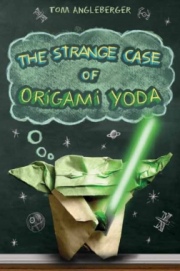
JBA Post #12: The Strange Case of Origami Yoda, Tom Angleberger

Only eight more to go!!! I read this book a while back and forgot to post about it until Ashley reminded me about it today.

I thought this book was HILARIOUS! It's about a group of middle school kids, and they have a classmate named Dwight who walks around with an origami Yoda (the Star Wars character) on his finger. Origami Yoda gives the kids great advice, and they set out to determine if he's real or not.

The book is set up just like a case file, with pictures, comments, and anecdotes from the different people involved. It was fun to see all the different characters' perspectives on Yoda's status, and I found myself giggling the whole time.

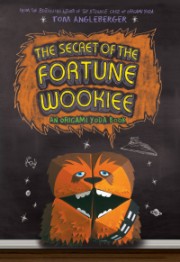
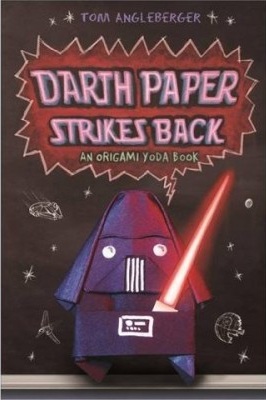
I can't wait to read Tom Angleberger's next book, Darth Paper Strikes Back. He also has another one coming out in August called The Secret of the Fortune Wookie. I'd recommend these books mainly to boys. They're pretty short, too, so they're good if you don't really have a lot of time to read.


JBA Post #11: Mamba Point, Kurtis Scaletta

For some reason when I picked this book up, I wasn't expecting to like it. And I was right - I really didn't enjoy it at all. In fact, it almost felt like a chore to read it. I found that my mind would wander so much while I read that I'd have to go back and reread pages because I had no idea what was going on in the story. It just really didn't hold my attention.

Anyway, the Linus Tuttle (a super nerd who has a nervous condition) finds himself moving to Africa after his father gets a job at the U.S. embassy in Liberia. Linus is sick of being known for his anxiety attacks and lack of friends, so he vows that he'll become a newer, cooler kid when he gets to Africa. This doesn't really work out, though.

What does happen is that Linus develops a strong connection with a black mamba snake - a snake that's supposed to be very dangerous to man...lethal, in fact. A native Liberian tells Linus that this connection is called a kaseng, and that the snake won't hurt him. The native is right, the mamba snake won't hurt Linus, but will his connection with it hurt someone else?

As I said earlier, I was pretty unimpressed with this book. Most of the novel was pretty mundane and tedious, and then when the action part FINALLY came, it was over quickly.

I just noticed that the author had an essay in the book Dear Bully that I read a while back - cool!