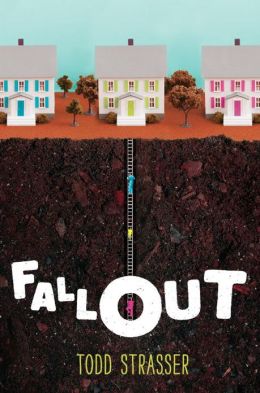
Wow! I loved
Fallout by Todd Strasser! Judging from the reviews and press I've read about the novel, it seems like most people did as well. I don't know why I didn't make the connection when I started reading, but I realized on his website that Strasser also wrote
The Wave, which I had to read in my 8th grade Reading class. I remember hating the teacher, but loving that book and its implications.
Fallout is set during the Cuban missile crisis. Things between the U.S. and Russia are tenser than ever, and all anyone can seem to talk about is whether or not this tension will result in a nuclear war. Main character Scott's father believes that it
will result in the war to end all wars, a nuclear war, and is determined to prepare his family for the worst. So, he builds the only nuclear bomb shelter in the neighborhood, right in the family's back yard. This becomes the subject of some ridicule for Scott and his younger brother Sparky, but all of that changes when a bombing actually occurs. Now, all the neighbors who were so critical at the start suddenly want in to the shelter to protect themselves and their children. Some of Scott's neighbors force their way in, and they spend a little over a week together cramped up in the shelter, getting to know each other more intimately than they ever imagined, all the while constantly wondering
if they'll get out and
what they'll see when they do.
I often find myself falling in love with characters, or caring about them in a way I would care about a real person. But this novel was different - I didn't actually feel a particular liking for any character (although I felt a particular
disliking for nasty-neighbor Mr. McGovern), but I experienced something I don't often get to with novels: I felt like I was right there with the characters. The way that Strasser described the tension in the shelter and the anxiety of the neighbors made me really feel like I was living it with them - horrifying and intriguing.
I also loved the way Strasser examined human nature - the way the characters changed from ridiculing Scott's dad's shelter to wanting in on it, and then once they were in, criticizing his hap-hazard gathering of items like food, water, clothing, etc. - the ultimate "looking a gift horse in the mouth," would have to be critiquing the man who saved your life. I really loved watching these changes unfold and seeing how unpredictable people can be when faced with catastrophic events. For instance, one of the characters, Mrs. Shaw, says she would never be able to sacrifice someone else's life to save her own. She's obviously shocked when she learns that her husband did just that: he helped Scott's dad keep too many people from getting into the shelter, essentially killing them.
The
only potential problem that I see with this novel, and I think it's one that can be avoided, is that kids might think this actually happened. I feel like most of the historical fiction kids read is based on a main event that actually happened, with other, minor events and characters being fictitious. However, the
major event in this novel is fictitious. There was no bombing. I would like to think that my students who read this book would be curious enough to do some of their own research, but I know that's not always the case. I'll be mindful of this when booktalking it and suggesting it to kids.
Also Try: 90 Miles to Havana, by Enrique Flores-Galbis;
A Long Walk to Water, by Linda Sue Park;
The Wave, by Todd Strasser
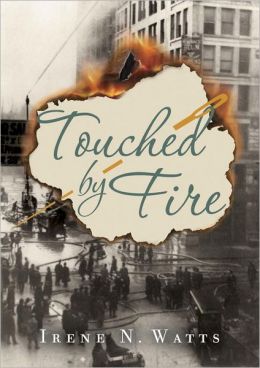 Miriam's family is originally from Russia, but flees to Germany during the pogroms in the early 1900s. During this time, Jewish towns and communities are being torched and demolished. Since Miriam's family is Jewish, they know that they've got to get away before they're destroyed by fire or something even worse. However, when they arrive in Germany, they know that things are not perfect even there, so Miriam's father, Sam, secures passage to America - to New York.