Showing posts with label foreign countries. Show all posts

Friday, August 9, 2013

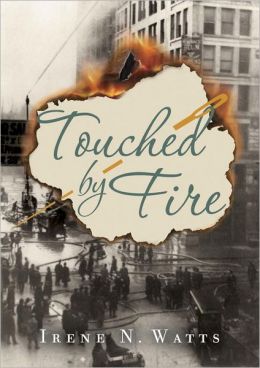
Touched by Fire, by Irene N. Watts

Some people think of fires as beautifully mesmerizing - campfires, bonfires, fires roaring in the fireplace on cold days. But for Miriam's family in Touched by Fire, fire represents a lifetime of struggle and hardship.

Touched by FireMiriam's family is originally from Russia, but flees to Germany during the pogroms in the early 1900s. During this time, Jewish towns and communities are being torched and demolished. Since Miriam's family is Jewish, they know that they've got to get away before they're destroyed by fire or something even worse. However, when they arrive in Germany, they know that things are not perfect even there, so Miriam's father, Sam, secures passage to America - to New York.

Before long, he's able to send three more tickets to America: one for Miriam, her mother, and her brother Yuri - they'll leave her grandparents and little sister behind for a while. But, only Miriam winds up going. She quickly lands a job in the Triangle Shirt Waist Company. During her time there, one of the most famous fires of New York - the Triangle Fire - occurs, and she loses several friends to the flames.

Miriam's mother and sister finally make it to America, but her brother Yuri never does. In the epilogue, years later, Miriam's nephew (Yuri's son) is living with a Nazi step-father, watching SS officers and Hitler Youth burn books around him, saying they'll burn the Jews next. Can he be saved?

I really liked the way the fire was woven throughout the novel - I think it helped really connect things and tie the story together. I also liked that this novel was relatively short, because I think a lot of times, my students get bogged down with historical novels that are good, but too long.

Also Try: Is it Night or Day?, by Fern Schumer Chapman; Flesh and Blood So Cheap, by Al Marrin

Wednesday, August 7, 2013

I Survived the Japanese Tsunami, 2011, by Lauren Tarshis

I Survived the Japanese Tsunami, 2011 (I Survived Series #8)In the wake of his father's death, Ben, his younger brother Harry, and his mother, travel to Japan to visit his dad's brother, whom he calls Ojisan. Ben has not really dealt with his father's death in a healthy way - he's torn down photos of him, stopped playing basketball (which they used to play together), and essentially just tried to erase his memory.

However, disaster soon strikes Japan. During the massive tsunami, Ben is separated from his family, yet somehow manages to stay alive and make it to a local school for shelter. He realizes, that through all of this, he was thinking of his dad and things his dad had taught him. He would not have survived the tragedy without the memories of his father.

Just like all the other I Survived books, I know this will be a big hit in my classroom. The kids love these survival stories, and I like them because they also teach them about real-world events.

Tuesday, August 6, 2013

The Nazi Hunters, by Neal Bascomb

To date, only one criminal has ever been sentenced to death in Israel. The Nazi Hunters tells the story of the capture and trial of this sole recipient of the death penalty - a World War II SS officer named Adolf Eichmann.
The Nazi Hunters is a fast-moving piece of narrative nonfiction, chronicling Eichmann's tracking and ultimate seizure outside of Buenos Aires, Argentina. The book explains that Argentina was a sort of safe-haven for lots of Nazis following the war, as the country generally sympathized with anti-Semitism, and allowed Nazis to assimilate into their culture.

That's what Eichmann and his family had done for several years, until his son Nick brings home a girl. Upon meeting Nick's father (who he says is his uncle), the girl - Sylvia - grows suspicious. She alerts her father of her concerns and they communicate the Israeli intelligence office. This tip leads to a lengthy investigation and covert operation by the Mossad, eventually landing in Eichmann's capture and conviction.

I loved that this book took place after World War II, examining what happened to the Nazis as they attempted to carry on with their lives. I think that's a part of the Holocaust that often gets overlooked - the focus is on the horrific events of concentration camps, but what happens to the war criminals is left untouched. This is a really interesting part of history to read and learn about.

I loved the way the book was written; it was very factual but at the same time read almost like a thriller. I know it will appeal to lots of my make students, and I always love having a new, great nonfiction title to recommend!

Side Note: I LOVE the cover - the colors and the images...awesome!

Also Try: Warriors in the Crossfire, by Nancy Bo Flood; Between Shades of Grey, by Ruta Sepetys; Maus, by Art Spiegelman

Monday, August 5, 2013

Into That Forest, by Louis Nowra

It's crazy to think how quickly we can lose what makes us 'human' - things like speech - but that's exactly what happens to two girls in Into that Forest. Hannah and Becky live simple, rural lives, but find their worlds turned upside down when Hannah's parents are killed in a boating accident in the Tasmanian bush. A pair of tigers - a male and female - approaches the girls and leads them to their shelter. At first, Becky is resistant, holding out hope that they will be rescued, but it's not long before the two girls have abandoned all of their human ways. They sleep with the lions, hunt with the lions, walk on all fours, and communicate with grunts and growls; they completely lose their ability to make words.

Years later, Becky's father discovers the girls after hearing reports that two humans were spotted hunting with tigers. He seemingly brutally captures the girls and attempts to assimilate them back into society. But after all they've been through, everyone involved discovers that this re-assimilation will be nearly impossible - they can't fully recoup their lost ways. One thing the girls will never lose, though, is their tragic bond.

I thought the idea behind this novel was incredibly interesting, but I found it a little too graphic for my taste. The descriptions of eating raw meat while with the tigers was a little too much for me to handle. My students do like survival stories, but I tend to think this might be a little much for them as well.

Friday, May 3, 2013

The Apothecary, by Maile Meloy

The Apothecary, Maile Meloy's first novel for middle grades, wasn't exactly what I was expecting, but it was a pretty good read.

The Apothecary is set in 1952, during the Cold War, when Americans were terrified of a Communist presence, and nations around the world began experimenting with new types of weaponry, namely the atomic bomb. Main character Janie Scott's parents are put on an FBI Communist Watch List, and they find that their only hope of living a semi-normal life is by moving out of the country. So, they relocate to London, leaving Janie feeling uprooted, out of sorts, and mildly depressed. All of that changes when Janie meets a mysterious classmate named Benjamin Burrows - he sets himself apart during a bomb drill when he refuses to "duck and cover," saying that in a real bomb drill, this tiny precaution would offer no salvation. She soon learns that Benjamin's father is an apothecary with some very important secrets. Actually, he's more than an apothecary; he's an alchemist, a magician. 
Janie's connection with the Burrows men leads her on some wild adventures, exposing her to dangerous villains, unthinkable magic spells, and a sea journey. 

To be totally honest, I got kind of bored towards the end of the novel, which is strange, because that's where the most action was - it just felt a little drawn out to me, I guess. Also, aside from Janie, I felt like the characters were pretty stock. There was the adventurous heroine (Janie), the headstrong, ill-fitted-to-the-family-business boy (Benjamin), the street-urchin sidekick with a Cockney accent (Pip), and the St. Beden's school Mean Girl (Sarah Pennington). Despite the predictability of the characters, I did like the waynarrator Janie described Sarah: 

"There are Sarah Penningtons in the United States - you probably know one, I'm sure they exist in France and Thailand and Venezuela. My Sarah Pennington, at St. Beden's, was a near-perfect specimen of her kind," (20). 

There is a sequel to The Apothecary - The Apprentices - which kind of surprised me, because I felt like the novel was wrapped up completely and could stand alone. It comes out at the beginning of June, so I'll have to check it out. 

Thursday, May 31, 2012

JBA Post #17: Boys Without Names, Kashmira Sheth

I honestly thought I was going to like Boys Without Names a lot more than I did. I love reading novels about children in places that are unfamiliar to me, especially the Middle East and Asia, so I thought this book would be right up my alley. Unfortunately, it wasn't.

The main character, Gopal, and his family live in India, on a farm. However, times have gotten tough and they are forced to sell their farm, but finances just keep getting worse. Gopal's parents owe a lot of money to a debt collector, and they decide that the only way to liberate themselves is to move away in secret, to the big city of Mumbai. Gopal's father has a brother there, and he says that he can secure work for Gopal's father, Baba.

The family journeys to Mumbai, and ultimately connects with the uncle, Jama. However, before meeting him, Baba disappears and Gopal, his mother, and twin brother/sister are left to fend for themselves. Gopal longs to make money and be able to contribute to his family's expenses and to thank Jama for his hospitality.

So, when Gopal meets a boy named Jatin who claims he can secure Gopal a job at his "uncle's factory", it sounds like perfection. Gopal soon learns that Jatin is a liar, and finds himself enslaved under a nameless man - whom he nicknames "Scar" - working his days away for little food with a group of other, nameless boys. Over time, Gopal becomes a sort of leader among the other slaves, and they look to him for advice, entertainment, and kindness.

The conditions Gopal and his fellow laborers work under are horrendous, and he vows to get out. Will he?

One of my biggest complaints about the novel is that it moves really slowly - everything seemed to be kind of drawn out and there was not a lot of action. Also, Baba disappears in the beginning and I was waiting for the ENTIRE novel to find out what happened to him, but never received that satisfaction...it really annoyed me!

I have one more JBA nominee to read, but there's only one day of school left...guess I won't be meeting my goal this year! :(

Friday, May 4, 2012

JBA Post #11: Mamba Point, Kurtis Scaletta

For some reason when I picked this book up, I wasn't expecting to like it. And I was right - I really didn't enjoy it at all. In fact, it almost felt like a chore to read it. I found that my mind would wander so much while I read that I'd have to go back and reread pages because I had no idea what was going on in the story. It just really didn't hold my attention.

Anyway, the Linus Tuttle (a super nerd who has a nervous condition) finds himself moving to Africa after his father gets a job at the U.S. embassy in Liberia. Linus is sick of being known for his anxiety attacks and lack of friends, so he vows that he'll become a newer, cooler kid when he gets to Africa. This doesn't really work out, though.

What does happen is that Linus develops a strong connection with a black mamba snake - a snake that's supposed to be very dangerous to man...lethal, in fact. A native Liberian tells Linus that this connection is called a kaseng, and that the snake won't hurt him. The native is right, the mamba snake won't hurt Linus, but will his connection with it hurt someone else?

As I said earlier, I was pretty unimpressed with this book. Most of the novel was pretty mundane and tedious, and then when the action part FINALLY came, it was over quickly.

I just noticed that the author had an essay in the book Dear Bully that I read a while back - cool!