Showing posts with label moving. Show all posts

Tuesday, April 1, 2014

Boy Nobody, by Allen Zadoff

Nobody knows his real name, he lives alone, he moves around a lot, and is smarter than most people you meet in a year. And he's only 16. Benjamin, as we know him for most of the novel, is "Boy Nobody" - an assassin hired and trained by "The Program", an agency that takes out threats to U.S. Security. Benjamin has worked on several cases, but the case we follow him through in this novel is the highest profile yet - he's assigned to take out the Mayor of New York City, and he's got to get close to the mayor through his gorgeous daughter, Samara. This could spell trouble for Benjamin; part of the reason he's so good at his job is that he never gets close to anyone. Not really anyway.

Benjamin can sense that his "Mother" and "Father" (not his real parents, but his directors in The Program) are worried he won't be able to complete his assignment, but he is determined to see it through, no matter what the cost. He has a sinking feeling that he may be up against something larger than anyone knows, but he can't let those suspicions cloud his judgment. Will he be successful?

I LOVED this book and know that it will really reach some of my more reluctant boy readers - there's lots of action, just a little bit of romance, and the chapters are short, letting the reader move through the book quickly. My students love books with short chapters. There was one part of the book I didn't like though. There's some indication that Ben's real parents might still be alive, but it's never really cleared up. I wish I knew that part of the story. In looking at Allen Zadoff's website, it looks like Boy Nobody's story will continue in a series - I can't wait! The next book is called I Am The Mission, and is due out in June.

Here's a trailer for the book:


Also Try: Hero, by Mike Lupica

Friday, January 31, 2014

The Impossible Knife of Memory, by Laurie Halse Anderson

I loved The Impossible Knife of Memory, by Laurie Halse Anderson, from the very first page. The novel opens:
“It  started in detention. No surprise there, right? Detention was invented by the same idiots who dreamed up the time-out corner. Does being forced to sit in time-out ever make little kids stop putting cats in the dishwasher or drawing on white walls with purple marker? Of course not. It teaches them to be sneaky and guarantees that when they get to high school they’ll love detention because it’s a great place to sleep.”

Halse Anderson is just so adept at capturing the teenage psyche and perpetuating it in the voice of her characters. I loved this about her last books and she lived up to my expectation in this one!

The Impossible Knife of Memory is about Hayley Kincain, whose mother is dead and whose father has recently returned from deployment. Suffering from post-traumatic stress disorder, Hayley’s dad has a hard time settling down and keeping a job; for this reason, they set out on cross-country trucking jobs, and Hayley is very loosely homeschooled. However, during her senior year, her dad decides it’s time for her to have a normal life and go to a real high school. So, they move back to the town where her dad grew up, into his mother’s old house, and Hayley begins her “normal” life. But, there’s nothing normal about having a dad who is fired more than he works, screams from nightmares in the middle of the night, and wavers between euphoria and depression. Hayley can’t focus on her schoolwork because she’s so worried about her dad. While attempting to avoid making friends, Haley eventually finds someone who can help her deal with her dad's situation. Will she be able to cope before her dad gets even worse?

This was an awesome book, but there were some sex scenes and inappropriate language, so I'd only recommend it for mature readers.

Friday, August 9, 2013

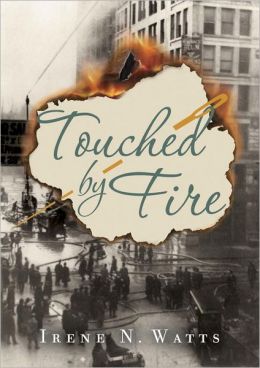
Touched by Fire, by Irene N. Watts

Some people think of fires as beautifully mesmerizing - campfires, bonfires, fires roaring in the fireplace on cold days. But for Miriam's family in Touched by Fire, fire represents a lifetime of struggle and hardship.

Touched by FireMiriam's family is originally from Russia, but flees to Germany during the pogroms in the early 1900s. During this time, Jewish towns and communities are being torched and demolished. Since Miriam's family is Jewish, they know that they've got to get away before they're destroyed by fire or something even worse. However, when they arrive in Germany, they know that things are not perfect even there, so Miriam's father, Sam, secures passage to America - to New York.

Before long, he's able to send three more tickets to America: one for Miriam, her mother, and her brother Yuri - they'll leave her grandparents and little sister behind for a while. But, only Miriam winds up going. She quickly lands a job in the Triangle Shirt Waist Company. During her time there, one of the most famous fires of New York - the Triangle Fire - occurs, and she loses several friends to the flames.

Miriam's mother and sister finally make it to America, but her brother Yuri never does. In the epilogue, years later, Miriam's nephew (Yuri's son) is living with a Nazi step-father, watching SS officers and Hitler Youth burn books around him, saying they'll burn the Jews next. Can he be saved?

I really liked the way the fire was woven throughout the novel - I think it helped really connect things and tie the story together. I also liked that this novel was relatively short, because I think a lot of times, my students get bogged down with historical novels that are good, but too long.

Also Try: Is it Night or Day?, by Fern Schumer Chapman; Flesh and Blood So Cheap, by Al Marrin

Wednesday, July 31, 2013

The Naturals, by Jennifer Lynn Barnes

The Naturals, the first in a new series by Jennifer Lynn Barnes and due out in November, is about a group of gifted kids recruited by the FBI to investigate (and potentially solve) cold cases. The group's gift lies in their natural ability to read people - to read emotions, to detect lies, to profile. Main character Cassie is a profiler; she can make accurate conclusions about a person's personality and lifestyle based upon seemingly minimal observation. At the start of the story, it's been five years since her mother's (unsolved) murder, and she's living with her father's family, but with the lingering feeling that she just doesn't belong. So, when she's approached by an agent to join the experimental project and move to Washington, D.C., she sees 'YES' as the only answer. She hopes that this will somehow eventually connect her to her mother's case, but she could never have expected how closely linked to it she will become. I won't spoil anything, but before long, Cassie herself is being pursued by a serial killer.

I found the more psychological aspect of the novel so interesting. Obviously, there's analysis of killers, crime scenes, and 'victimology' which was interesting, but more than that I liked the interactions of the various participants in the Naturals group. They're all late teenagers, they all live in a secluded house, they all have an inherent gift, and, of course, they all carry their own unique load of baggage. I love watching their interactions and personalities unfold.

I often pride myself on the fact that when reading mysteries, I can usually figure out 'whodunit' if you will, but this time I really couldn't! I was utterly convinced that the killer in the novel was one of two characters, neither of whom actually turned out to be the culprit. I'd like to think that I just wasn't reading carefully enough, since I was also watching my 13-month-old son while reading, but I don't think that's the case - I think that Jennifer Barnes's plot, characters, and writing are JUST THAT GOOD.

Amazon recommends this novel for ages 12 and up on their website, but I think I'd go more with 14 or 15 and up. The killing scenes are quite graphic - carving off of facial skin and keeping lipsticks as mementos of the kill - and there's some motivation behind a sexual motivation for the murders. I do think that it's these details that make the novel so great though - they make it seem so real.

Also Try: The Name of the Star, by Maureen Johnson; Shadowlands, by Kate Brian; "The Squad" series by Jennifer Lynn Barnes

Release Date: November 5, 2013

Monday, July 29, 2013

Living with Jackie Chan, by Jo Knowles

Living with Jackie ChanGood news and bad news about Living with Jackie Chan, by Jo Knowles. The good news is that I absolutely loved it...I read it from NetGalley in about four hours. The bad news is that I hadn't read anything by Jo Knowles sooner - really looking forward to trying Jumping Off Swings and See You at Harry's.

Living with Jackie Chan is about a high school senior, Josh, who moves in to live with his uncle right before his senior year. He got a girl pregnant back home, his home life is a mess, and he feels like relocating is the only way to give himself a fighting chance at getting his life back on track. His uncle, Larry, is a karate and Jackie Chan-obsessed nutjob, but he turns out to be exactly what Josh needs. He drags Josh to karate classes, where Josh meets their neighbor Stella, and develops a quick but complicated friendship. While navigating the ropes of a new school, new living situation, and a new friend, Josh is still coming to terms with the guilt that he feels over the pregnancy. It does not help matters that the people who live above his uncle have a baby - a constant reminder of what he did.

I loved the way Living with Jackie Chan unfolded, and the way it examined the dynamics of a boy/girl teen friendship, secrets, and reinventing ourselves. I do think it's a little mature for some of my students, but the novel focused more on the way the characters were positively changed than on the act itself, so I think it will be okay for most.

Also Try: How to Save a Life, by Sara Zarr; Jumping Off Swings, by Jo Knowles

Monday, July 8, 2013

Right Behind You, by Gail Giles

I found this title on another blog (can't remember which one!) as a suggestion for a great read-aloud and a great discussion-starting book. It was certainly that - discussion starting - but unfortunately, I don't think I'll be able to use it in my classroom. It had lots of bad language and some really mature content that most of my readers aren't ready for. It was an awesome book though, and I thought it taught a really good lesson.

Right Behind You is about a boy, Kip (or Wade, depending on where you are in the story) who killed another boy. It's not spoiling anything to tell you that - the opening page of Kip's narrative is, "On the afternoon of his seventh birthday, I set Bobby Clarke on fire. I was nine. It was all about Bobby's birthday present. A baseball glove." From there on out, Kip's story unfolds and the things he went through as a child murderer are laid out. I thought it was so interesting to see things from the killer's perspective, and to see the struggles he went through during four years in a mental institution and beyond.

Like I said before, this book teaches such an awesome lesson in empathy and in second chances that I wish I could use it in my classroom! I would recommend it to anyone in upper high school - I feel like everyone could stand to benefit from reading Right Behind You.

Tuesday, July 2, 2013

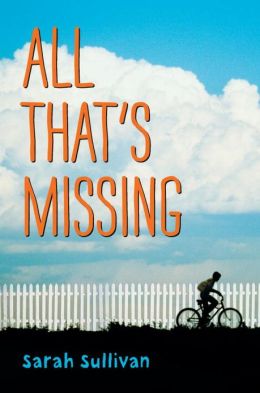
All That's Missing, by Sarah Sullivan

I've recently registered with Net Galley, a website that lets you read and review advance copies of novels. Obviously, I've requested to read lots of Children's Fiction/YA, but they have really great adult titles, too!

My first Net Galley book was All That's Missing, by Sarah Sullivan. This is the author's first novel, although she's written a few picture books, and I was really impressed.

All That's MissingI always have a group of male readers who are not at all into the fantasy/sci fi thing, nor are they in to sports novels. They're just into realistic fiction with male protagonists - finding that sans romance can often be trying at best. I think this novel fits the mold, and can't wait to recommend it to my students next year.

The novel's main character, Arlo, lives with his grandfather, whom he calls "Poppo". Arlo's parents both died in a car accident when he was two, and Poppo is the only family he's ever known. He knows of a grandmother, but he can't recall ever meeting her. Arlo's life becomes increasingly complex as dementia begins to prey upon his grandfather's brain - Arlo finds himself trying to squeak by in school whilst keeping tabs on his grandfather, and making sure no adults in the community find out.

Finally, Arlo can hide it no longer and Poppo is taken to the hospital after wandering out in the middle of the night and suffering from a stroke. Since Arlo can't give the social worker he meets at the hospital any other family member's names, he's taken into custody of the state and sent to an orphanage for the night. He realizes quickly that he cannot sustain that life or play into its uncertainty, so he breaks free, vowing to find his grandmother.

His plan works, but the transition to living with Grandma is no piece of cake. Grandma hated Arlo's mother, and his grandmother's past seems to be rife with secrets that he's not privy to. Things eventually work out (I'll let you read to figure out how!), but not before Arlo saves his grandmother's house from an ill-intentioned crook, gets a history lesson on Prohibition and bootleggers, and learns the truth about his parents' past.

I thought that so many aspects of the novel would be super-relatable to my middle school students, and there was one quote in particular that I really loved:

"...the thing about families, Arlo thought, was that there was always some question nobody wanted to answer, and it was like a stray thread pulling loose in a sweater. You could tug at it all you wanted, but in the end, all you'd have was a pile of twisted yarn."

Look out for All That's Missing, coming out October, 2013. 


Tuesday, April 30, 2013

Waiting to Forget, by Sheila Kelly Welch

Last year, I read all of the books on South Carolina's Junior Book Award Finalist and found that I thoroughly enjoyed most of them; Waiting to Forget is one of this year's books, and after reading it, I'm encouraged to attempt the whole list again this year.

Waiting to Forget is about two young children, T.J. and Angela, who have been in and out of foster care for their whole lives and have recently landed a permanent adoptive home. Soon after being adopted, Angela (the younger sibling) is in a accident - the details of the accident aren't revealed until the very end of the novel - so the book takes place in the waiting room of a hospital, as T.J. ponders where they've been, what they've seen, and how they've gotten to this point in their lives. The entire narrative is told in alternating chapters "Then" (when he and Angela lived with their mother and various foster families) and "Now" (while sitting in the hospital waiting room, and is revealed through T.J.'s "Life Book", which he was forced to make as a therapy project by one of his social workers.

I loved the simplistic, to-the-point style of the novel - the narrator described everything that T.J. and his sister went through with a very matter-of-fact tone, which for some reason worked to make things all the more emotional. T.J.'s mother had a string of no-good boyfriends who inevitably put the kids in trouble, and the way these evil characters were described, through their actions, was great.

Throughout the whole novel, T.J. founds himself pondering the difference between lies and reality, especially as he finds himself lying for his mother to keep her out of trouble. This novel really made me think about how we lie to protect people, even when we know it's not necessarily in our best interest.

Through the course of this short novel, T.J. undergoes a complete transformation in terms of his views of his past life and current situation, and I loved the way it was brought about through the contrast between the "Then" and "Now" chapters.

Although this novel is nowhere near as graphic as A Child Called It, which I think is part of what attracted my students to that book, I think that it will be popular in my classroom - my students love to read sort of real-life survival stories, and that's exactly what this was.

Finally, I really loved the cover of the book! I loved the simple black and white with the one pop of color. Those little origami cranes are important in the novel...but I'll let you figure out how!

Sunday, October 28, 2012

Liar and Spy, Rebecca Stead


This is the second book I've read by Rebecca Stead. The first one was called When You Reach Me, and I read it a few years back for a college class. My professor for that class was Dr. Jennifer Wilson, the best teacher I've ever had. When You Reach Me had won the Newbery Medal that year, and we had to read it and then complete a project either questioning or validating the legitimacy of medals and awards like the Newbery. Dr. Wilson unfortunately died in 2011, and that's part of the reason I really wanted to read this book - it reminded me of her.

Georges, the main character in Liar and Spy is one of those stereotypical weird kids. He's weird right down to his name...the 's' on 'Georges' is silent, so it's really just George. His parents are big fans of a painter named Georges Suerrat, his namesake. Anyway, Georges's dad loses his job, and the family finds themselves relocating from their luxurious, custom home to an apartment complex in Brooklyn. There, Georges meets a boy named Safer, who just might be weirder than Georges himself. Safer has two siblings, a sister named Candy and a brother named Pigeon. Rumor is that the children were allowed to name themselves.

Aside from struggling with the big move, trying to fit in at school, and befriending the odd birds of Safer's apartment, Georges's mom is almost completely out of the picture. The story is that she's working double shifts at the local hospital to make up for the dad's lost job. Georges has no real communication with her aside from notes that they leave each other written out in Scrabble letters each morning/night - she's already at work when he goes to school and home in bed when he gets home.

There's a strange air of mystery throughout the whole novel, like Georges is hiding something. For a while I thought that maybe the dad was having an affair, or maybe the mom had actually moved away. The confusion is finally cleared up in the end of the novel, and it's a big surprise.

This novel was very similar to When You Reach Me in that the chapters seemed disjointed, and sometimes the link between all of the different happenings in the novel seemed vague. However, it's all wrapped up nice and neatly in the end.